Advoke International

Advoke International

  • About
  • Privacy
    • General Data Protection Regulation (GDPR), EU/UK
      • GDPR Gap Analysis
      • Privacy Framework Implementation
      • GDPR Readiness Assessment (Audit)
      • Complete GDPR Compliance Review
      • EU/UK GDPR Representative
      • _
    • Digital Personal Data Protection Act (DPDPA), India
      • DPDPA Gap Analysis
      • Privacy Framework Implementation
      • DPDPA Readiness Assessment (Audit)
      • Complete DPDPA Compliance Review
      • _
    • Health Insurance Portability and Accountability Act (HIPAA), USA
      • HIPAA Gap Analysis
      • Privacy Framework Implementation
      • HIPAA Security Framework Implementation
      • HIPAA Readiness Assessment (Audit)
      • Complete HIPAA Compliance Review
      • _
    • California Privacy Rights Act & Other Legislations (CPRA+), USA
      • CPRA+ Gap Analysis
      • Privacy Framework Implementation
      • CPRA+ Readiness Assessment (Audit)
      • Complete CPRA+ Compliance Review
      • _
    • Personal Data Protection Law (PDPL), UAE
      • PDPL Gap Analysis
      • Privacy Framework Implementation
      • PDPL Readiness Assessment (Audit)
      • Complete PDPL Compliance Review
      • _
    • Dubai International Financial Centre (DIFC) Data Protection Law, UAE
      • DIFC Gap Analysis
      • Privacy Framework Implementation
      • DIFC Readiness Assessment (Audit)
      • Complete DIFC Compliance Review
      • _
    • Abu Dhabi Global Market (ADGM) Data Protection Regulations, UAE
      • ADGM Gap Analysis
      • Privacy Framework Implementation
      • ADGM Readiness Assessment (Audit)
      • Complete ADGM Compliance Review
      • _
    • Federal Act on Data Protection (FADP), Switzerland
      • FADP Gap Analysis
      • Privacy Framework Implementation
      • FADP Readiness Assessment (Audit)
      • Complete FADP Compliance Review
      • _
    • Personal Information Protection and Electronic Documents Act (PIPEDA), Canada
      • PIPEDA Gap Analysis
      • Privacy Framework Implementation
      • PIPEDA Readiness Assessment (Audit)
      • Complete PIPEDA Compliance Review
      • _
    • Personal Data Protection Act (PDPA), Singapore
      • PDPA Gap Analysis
      • Privacy Framework Implementation
      • PDPA Readiness Assessment (Audit)
      • Complete PDPA Compliance Review
      • _
    • Virtual Data Protection Officer (vDPO) Services

    • View All
  • InfoSec
    • ISO/IEC 27001
    • ISO/IEC 27701
    • SOC 2, Type I/II
    • PCI-DSS
    • NIST Cybersecurity Framework (CSF)
  • Compliance
    • Policy Solutions for Websites and Applications
    • Business Policy Development
    • Technology Contracts
    • Business Agreements
    • Commercial Contracts
    • Corporate Compliance Advisory
  • Resources
    • Knowledge Base
  • Contact
CONNECT
LOG IN

Privacy Concept #5: Legal Basis for Processing of Personal Data

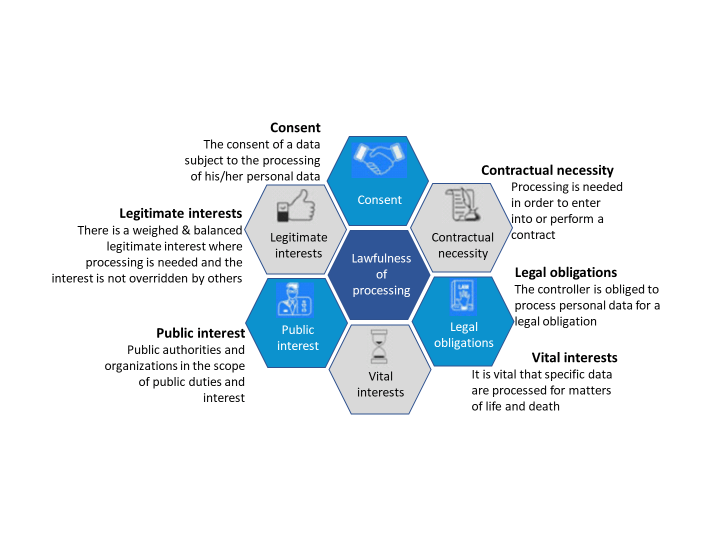
The Legal Basis for Processing of Personal Data refers to the lawful grounds under privacy laws that justify data processing. These include consent, contract performance, legal obligations, vital interests, public interest, and legitimate interests, ensuring that personal data is processed fairly and lawfully.


The lawfulness principle under data protection frameworks like the EU GDPR, UK GDPR, Indian DPDPA, Swiss FADP, and DIFC Data Protection Law requires that the processing of personal data must have a legitimate legal basis. Organizations must establish and document the reason for processing personal data, ensuring that it aligns with the applicable legal requirements. This principle safeguards individuals’ rights and fosters trust in how their personal data is used.

Recognized Legal Bases for Processing of Personal Data

Consent

Processing is lawful if the data subject provides explicit, informed, and freely given consent. Organizations must ensure consent is specific and can be withdrawn at any time.

  • Example: A retail company requests customer consent to send promotional emails.

Performance of a Contract

Data can be processed if necessary to fulfil a contract or to take steps before entering into one.

  • Example: An e-commerce website processes a customer’s address to deliver purchased goods.

Legal Obligation

Processing is lawful when it is required to comply with legal obligations imposed on the organization.

  • Example: A company processes employee data to comply with tax filing requirements.

Vital Interests

Processing is justified to protect the vital interests of the data subject or another person, typically in life-threatening situations.

  • Example: A hospital shares a patient’s data with another healthcare provider during a medical emergency.

Public Interest or Official Authority

Processing is lawful when it is necessary for tasks carried out in the public interest or under the official authority of the controller.

  • Example: Government agencies process census data to plan public services.

Legitimate Interests

Organizations can process data for legitimate interests, provided such processing does not override the rights and freedoms of the data subject. A balancing test must be conducted to ensure this.

  • Example: A business uses customer purchase history to recommend related products, ensuring the data is used responsibly and without causing harm.

Variations Across Jurisdictions

  • EU GDPR and UK GDPR: These frameworks recognize all the bases mentioned above and provide detailed guidelines on obtaining and documenting consent, conducting legitimate interest assessments, and balancing rights.
  • DPDPA (India): The Digital Personal Data Protection Act (2023) emphasizes consent as a primary basis for processing but also recognizes “deemed consent” in specific contexts, such as compliance with legal obligations or emergency situations.
  • Swiss FADP: Similar to GDPR, the Swiss FADP allows processing based on consent, contractual necessity, legal obligations, vital interests, or public tasks but may tailor these bases to local legal requirements.
  • DIFC Data Protection Law: Recognizes similar bases while providing sector-specific regulations that ensure compliance with both local and global standards.

Why Legal Basis Matters

  1. Compliance and Accountability: Identifying the legal basis ensures compliance with applicable laws and demonstrates accountability, reducing the risk of penalties for non-compliance.
  2. Transparency: By clearly stating the legal basis for processing, organizations build trust with individuals and ensure transparency in their data handling practices.
  3. Data Subject Rights: The legal basis determines the scope of data subject rights, such as the right to object to processing. For example, individuals may object to processing based on legitimate interests but not to processing required by legal obligations.

Understanding and applying the appropriate legal basis for processing is fundamental to achieving lawful data processing under global data protection frameworks. While consent remains a common legal basis, organizations must consider alternatives such as contractual necessity, legal obligations, or legitimate interests depending on the context. Ensuring that the chosen basis aligns with the rights of individuals and the applicable laws is key to fostering trust and accountability in data processing.

Frequently Answered Questions

When should a business rely on consent as the legal basis for processing data?

Businesses should rely on consent when the processing is not necessary for the performance of a contract or legal obligation, and when the data subject’s voluntary, informed, and explicit consent is required. For example, consent is often used for marketing activities, like sending promotional emails.

How can a business ensure that consent is valid under data protection laws?

Consent must be explicit, informed, and freely given, with a clear option to withdraw at any time. Organizations should ensure that consent requests are clear and specific (e.g., separate checkboxes for different types of processing) and that they can easily prove consent was obtained.

What steps can businesses take to ensure transparency and accountability regarding their legal basis for processing?

To ensure transparency and accountability, businesses should clearly document and communicate the legal basis for data processing in their privacy policies. They should also ensure that data subjects can easily exercise their rights (such as consent withdrawal or data access) and that internal processes support compliance with the chosen legal bases.

What is a “balancing test” when processing data under legitimate interests, and how should businesses conduct it?

A balancing test is required when processing data under legitimate interests. It involves weighing the organization’s interests against the rights and freedoms of the data subject. Businesses must assess whether the processing is necessary, proportional, and does not cause harm to individuals. If legitimate interests are pursued, the business must document the assessment and be prepared to justify it.

  • About
  • Privacy
    • General Data Protection Regulation (GDPR), EU/UK
      • GDPR Gap Analysis
      • Privacy Framework Implementation
      • GDPR Readiness Assessment (Audit)
      • Complete GDPR Compliance Review
      • EU/UK GDPR Representative
      • _
    • Digital Personal Data Protection Act (DPDPA), India
      • DPDPA Gap Analysis
      • Privacy Framework Implementation
      • DPDPA Readiness Assessment (Audit)
      • Complete DPDPA Compliance Review
      • _
    • Health Insurance Portability and Accountability Act (HIPAA), USA
      • HIPAA Gap Analysis
      • Privacy Framework Implementation
      • HIPAA Security Framework Implementation
      • HIPAA Readiness Assessment (Audit)
      • Complete HIPAA Compliance Review
      • _
    • California Privacy Rights Act & Other Legislations (CPRA+), USA
      • CPRA+ Gap Analysis
      • Privacy Framework Implementation
      • CPRA+ Readiness Assessment (Audit)
      • Complete CPRA+ Compliance Review
      • _
    • Personal Data Protection Law (PDPL), UAE
      • PDPL Gap Analysis
      • Privacy Framework Implementation
      • PDPL Readiness Assessment (Audit)
      • Complete PDPL Compliance Review
      • _
    • Dubai International Financial Centre (DIFC) Data Protection Law, UAE
      • DIFC Gap Analysis
      • Privacy Framework Implementation
      • DIFC Readiness Assessment (Audit)
      • Complete DIFC Compliance Review
      • _
    • Abu Dhabi Global Market (ADGM) Data Protection Regulations, UAE
      • ADGM Gap Analysis
      • Privacy Framework Implementation
      • ADGM Readiness Assessment (Audit)
      • Complete ADGM Compliance Review
      • _
    • Federal Act on Data Protection (FADP), Switzerland
      • FADP Gap Analysis
      • Privacy Framework Implementation
      • FADP Readiness Assessment (Audit)
      • Complete FADP Compliance Review
      • _
    • Personal Information Protection and Electronic Documents Act (PIPEDA), Canada
      • PIPEDA Gap Analysis
      • Privacy Framework Implementation
      • PIPEDA Readiness Assessment (Audit)
      • Complete PIPEDA Compliance Review
      • _
    • Personal Data Protection Act (PDPA), Singapore
      • PDPA Gap Analysis
      • Privacy Framework Implementation
      • PDPA Readiness Assessment (Audit)
      • Complete PDPA Compliance Review
      • _
    • Virtual Data Protection Officer (vDPO) Services

    • View All
  • InfoSec
    • ISO/IEC 27001
    • ISO/IEC 27701
    • SOC 2, Type I/II
    • PCI-DSS
    • NIST Cybersecurity Framework (CSF)
  • Compliance
    • Policy Solutions for Websites and Applications
    • Business Policy Development
    • Technology Contracts
    • Business Agreements
    • Commercial Contracts
    • Corporate Compliance Advisory
  • Resources
    • Knowledge Base
  • Contact

Global solutions for privacy, information security and technology compliances

Advoke International
Sheikh Rashid Tower, 1703 Sheikh Zayed Rd, Trade Centre 2, World Trade Centre, Dubai, United Arab Emirates

  • LinkedIn
  • WhatsApp
  • Mail

© 2025 Advoke International. All rights reserved.


Privacy Notice

Terms of Use

Cookie Policy